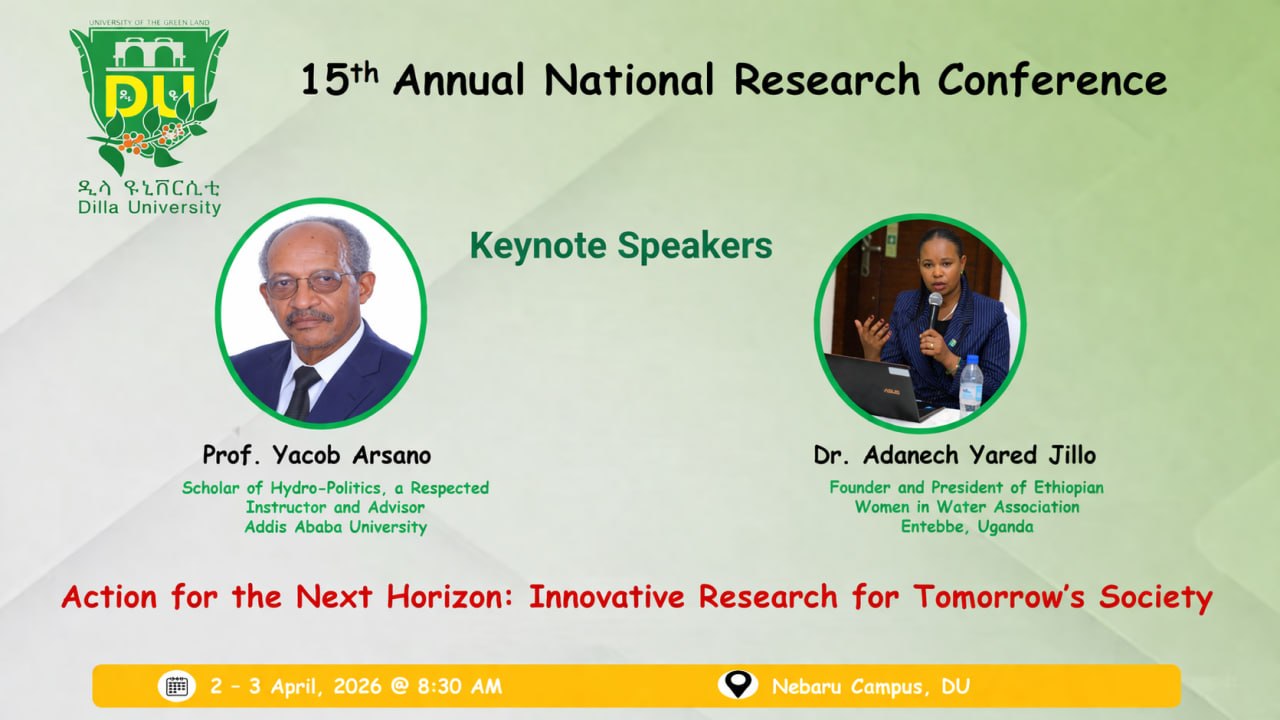
Dilla University held the 13th National Education Research Conference on January 1, 2026, under the theme “Revitalizing Applied Education: Igniting Innovation, Empowering the Future.” The conference was organized by the Research and Technology Transfer Vice President Officethrough theResearch, Publication, Ethics and Dissemination Directorate (RPED) and brought together university leaders, scholars, and invited experts to deliberate on national education priorities.
The program opened with a welcoming address by Dr. Misganu Legesse (PhD, Associate Professor), Director of RPED. He emphasized the indispensable role of education in human capital development and national transformation and reaffirmed Dilla University’s vision of becoming a nationally competitive and internationally recognized innovative university by 2030. He noted that, as a University of Applied Science, DU is committed to enhancing the relevance and practicality of education through research, dissemination, and stakeholder engagement.
A welcoming speech followed by Dr. Habtamu Temesgen (PhD, Associate Professor), Vice President for Research and Technology Transfer. He welcomed participants, acknowledged the keynote speakers, and highlighted DU’s achievements in research, community engagement, and technology transfer. He also mentioned the development of a coffee-focused Master’s degree curriculum and noted that DU has revised its curricula, aligned research with national priorities, and automated its research management system. He further stated that DU earned a Gold-tier Certificate of Compliance from the African Academy of Science and Global Grant Communityfollowing an external audit by KPMG Kenya, making it the only public university in Ethiopia to receive this recognition.
The first keynote address was delivered by Professor Yalew Indawoke Mulu, CEO of Statistics and Policy Research at the Federal Civil Service Commission, on “Dehumanizing and Nihilistic Education: The Need to Revitalize Ethiopian Education to Create Humanized Learners.” He critically assessed the current education system, arguing that it produces learners who are informed but not enlightened, and called for an education that nurtures ethical values, critical thinking, and holistic human development.
The second keynote speaker, Professor Abdi Edriss, Professor of Applied Economics, Statistics, and Data Science at Lilongwe University of Agriculture and Natural Resources, Malawi, spoke on “Building Ethiopia: The Transformative Role of Universities in Developing Human Capital for Sustainable Socio-Economic Progress.” He emphasized the importance of human capital, data-driven decision-making, stakeholder-informed curricula, and stronger links between research, community engagement, and employability.
The conference also featured parallel panel discussions involving Dr. Birhanu Mekonnen, Dean, Institute of Education and Behavioral Sciences); Dr. Tamirat Beyene, Vice President for Academic Affairs, and Dr. Dereje Kiflie, Executive Director of Hassedella Campus, focusing on applied education and higher education reform. The event concluded with closing remarks by Dr. Mathios Habte, Vice President for Administrative and Development Affairs, who commended the organizers and participants for a successful conference.